
The 50-Minute Hour Has a Blind Spot: 10,080 minutes.
Your clients live 10,080 minutes a week. You see 50 of them. The research on between-session monitoring shows what you're missing — and why it matters for outcomes.
Your clients live 10,080 minutes a week. You see 50 of them. The research on between-session monitoring shows what you're missing — and why it matters for outcomes.

Your clients are using AI mental health tools between sessions — whether you know about it or not. Here's the ethical framework every clinician needs before recommending, encountering, or addressing these tools.

The research on self-report bias in clinical settings is unambiguous — your clients can't give you an accurate picture of their week. Here's the neuroscience behind why, and what to do about it.

Most mental health crises don't happen in your office. They happen between sessions — and the research shows clinicians have almost no visibility into them until it's too late.
Design Principles Standard AI safety tests use cold prompts with no user history. That methodology is valid for stateless systems. EQ is not a stateless system. EQ’s architecture is predicated on longitudinal context — the Counterweight Query only functions when there is history to pull from. This matrix tests the

It’s a reasonable question. You’re in pain, it’s 2am, and there’s something on your phone that will listen without judgment, without a copay, without a six-week waitlist. So you use it. Millions of people do. And then, somewhere in the back of your mind, you
If you teach a dog to sit by giving it a treat, what have you actually taught it? To sit? Or to perform the appearance of sitting? The distinction sounds academic. Until you realize that the same question — applied to artificial intelligence — is why a man named Jonathan Gavalas is
In the world of Silicon Valley, there is a metric that rules everything: Engagement. Most AI models are built to keep you talking. They are trained to be "helpful" and "agreeable." If you tell a standard AI that you are feeling victimized, it will nod along.
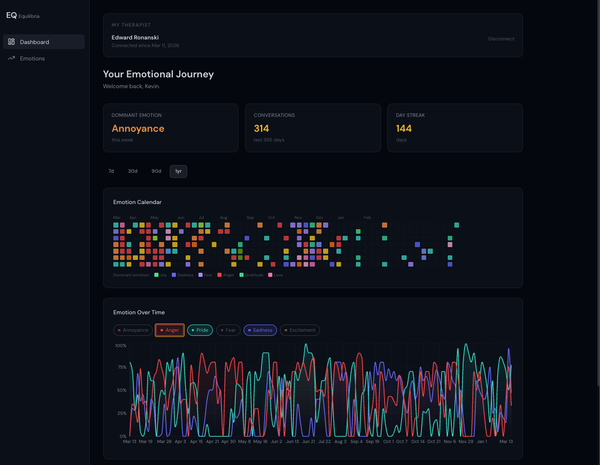
For decades, the first fifteen minutes of a therapy session have followed a predictable ritual. The clinician asks, "How was your week?" and the client provides a subjective summary filtered by the fog of recency bias. In this model, the therapist is often a step behind, reacting to